
 the consumer brand of Nium
Money Transfer App Development for a Fintech Unicorn's Consumer Brand.
We took full ownership of Instarem's mobile app, from user research to App Store launch, and built a cross-platform money transfer app that hit 10,000 downloads in its first month.


About this engagement
Instarem is a Singapore-founded cross-border payments platform that sends money to 60+ countries at rates close to the mid-market rate. Its founding team later rebranded the parent company as Nium, which became a fintech unicorn in 2021, and Instarem continues as Nium's consumer brand. But users had no mobile-first way to send money abroad: they relied on bank branches or traditional remittance operators, with hidden fees and transfers that took 3–5 days.
We took full ownership of the mobile app, from product discovery and user research through UI/UX design, React Native development, payment integrations and KYC across 11 jurisdictions. This was fintech app development end to end, and the app launched to 10,000 downloads in its first month, with 65% of users returning the next day.
Challenges in cross-border money transfer
International money transfers were slow, expensive and hard to follow. Instarem's payment rails could move money in minutes, but users had no simple way to use them from their phones, and every market came with its own fintech regulations.
For remittance users, every hidden fee and every extra day matters.
The four challenges
Four problems kept users tied to banks and traditional operators, and the app had to solve all of them while meeting regulators in every market.
No mobile-first experience
Users couldn't send money, track rates or manage transfers on the go. Everything meant a desktop or a branch visit.
Edge cases the app had to handle
Instarem already had fast payment rails and its own exchange rate technology. What it lacked was an app that could put them in users' hands across 60+ countries. Doing that meant handling five edge cases that a typical payments app never faces.
- 01Unreliable internet connections
Many users were in markets with patchy connectivity, so the app couldn't assume a stable connection.
- 02Very different levels of financial literacy
Some users were experienced with international transfers; others were sending money abroad for the first time.
- 03A different payment method in every market
Users expected their local options, like PayNow in Singapore, PayID in Australia and UPI in India, alongside cards and bank transfers.
- 04Strict KYC that couldn't scare users off
Identity checks had to satisfy 11 regulators without turning sign-up into a wall that made new users give up.
- 05Exchange rates that change constantly
Users needed to see the live rate before sending, across 10 sending currencies and 35+ receiving currencies.
Solution: money transfer app development with compliance built in
We approached this as full-stack fintech app development: one cross-platform app, with compliance and security designed into the architecture from day one, and every feature shaped by what users actually needed.
What a cross-border remittance app needed
A standard payments app wouldn't work across 60+ countries. Instarem's app needed three things, and each one shaped what we built.
One codebase for iOS and Android
Two separate native apps across 60+ countries would have doubled the work. So we built a single React Native codebase with near-native performance.
Compliance in the architecture, not added later
Retrofitting compliance across 11 jurisdictions would have been slow and costly. So we built progressive KYC and fintech regulatory compliance into the app's foundations.
An app that works on any connection
Users in emerging markets couldn't depend on stable internet. So we designed an offline-first data sync, so the app keeps working when the connection doesn't.
The three layers of the app
The app is built in three layers, each solving a different part of the problem.
Core transfer engine
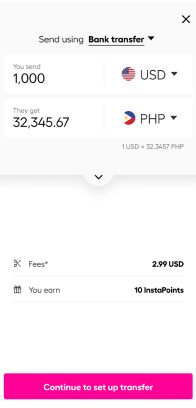
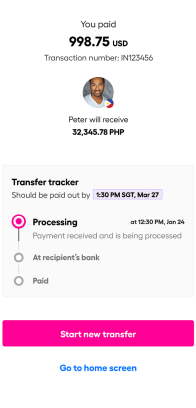
The transfer flow shows live exchange rates over WebSocket across 10 sending and 35+ receiving currencies. It supports bank transfers, cards and local payment methods like PayNow, PayID and UPI in one experience, making it a complete payment solution software development project rather than a front end on top of existing rails.
Security and compliance layer
Bank-grade encryption, biometric login with Touch ID and Face ID, certificate pinning, secure document storage and fraud detection integration were built in from the start. These meet the cybersecurity standards for fintech companies that regulators and users expect. A progressive KYC flow verifies identity in steps, keeping sign-up simple while meeting all 11 regulators.
Engagement and growth features
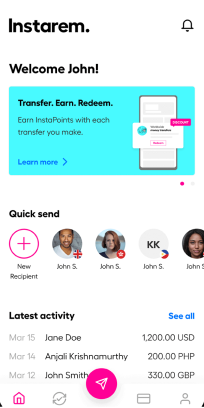
The InstaPoints rewards program, rate alerts for preferred exchange rates, and referral mechanics give users reasons to come back, turning the app from a one-off utility into a regular financial tool.
How we built it
We worked in two-week sprints, integrated directly with Instarem's product, compliance and banking teams, and built the app in three stages.
Learning from 100+ users before designing
We interviewed more than 100 potential users across target markets, mapped their personas and journeys, and set the technical architecture: app structure, API design, security framework, payment integrations and offline sync.
Why we chose this technology
Each part of the stack was chosen to deliver a fast, secure app on both platforms from one codebase.

Outcomes: From soft launch to 60+ countries
Instead of launching everywhere at once, we launched in one market, proved the app worked, then expanded. Here's how the money transfer app grew, from the first beta users to Instarem's scale today.
Before launch: testing for every market
We tested the app on 20+ devices and ran security audits and compliance checks, so it was ready for the range of phones and regulators it would meet.
Soft launch: Australia first
We released the app to beta users in Australia, the first market, to validate it with real users before rolling it out further.
Month one: 10,000 downloads
The app reached 10,000 downloads in its first month, and 65% of users came back the next day. That return rate came from a UX built for every level of financial literacy, rate alerts, InstaPoints rewards and pricing users could trust.
First quarter: $10M in transactions
Users moved $10M through the app in its first quarter.
Expansion: country by country
We rolled the app out to more countries one at a time, monitoring and optimizing performance as usage grew 30% month over month. The app held 99.9% crash-free sessions throughout.
Later: an award-winning app at unicorn scale
Instarem won fintech awards including Best Value International Money Transfer Provider. It has since grown to over 1 million users, and Nium, the company behind it, became a fintech unicorn in 2021.
FAQs about money transfer app development
Design compliance into the architecture from the start, rather than adding it later. For Instarem, we built a progressive KYC flow that met the requirements of financial authorities in 11 jurisdictions, along with secure document storage, fraud detection integration and bank-grade encryption, all designed to scale as Instarem entered new markets.
React Native lets one codebase serve both iOS and Android with near-native performance. For Instarem, that meant 60fps animations, a 2-second launch time and 99.9% crash-free sessions, while cutting development time and cost compared with building two separate native apps for 60+ countries.
At a minimum: bank-grade encryption, biometric login, certificate pinning to protect data in transit, secure storage for identity documents, and fraud detection. These protect both users' money and the identity data that KYC requires.
Verify identity progressively, asking for information in steps rather than all at once. Instarem's KYC flow kept the first experience simple while still meeting every regulator's requirements.
Facing similar challenges? See how we can help.
If you're planning money transfer app development or any regulated fintech product, tell us what you're building, and we'll show you how we'd approach it.
Talk to our team →
Let’s Build your Project Together