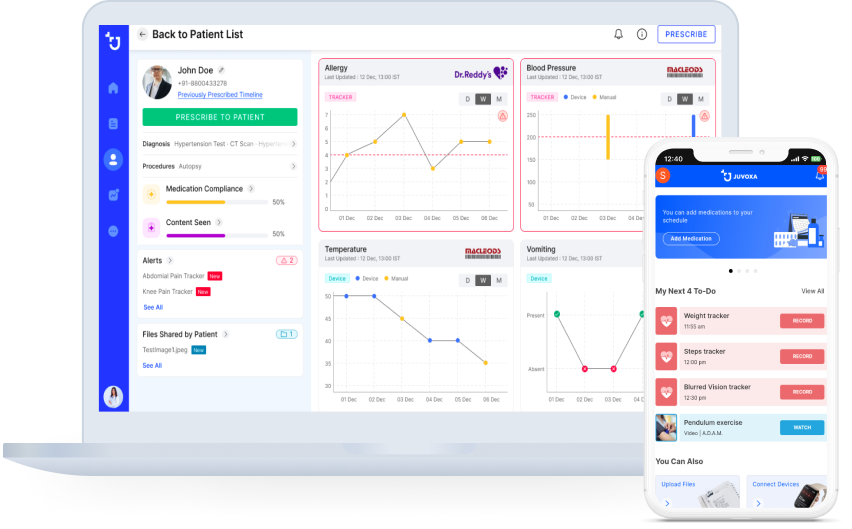
Ajackus designed and built Juvoxa’s complete digital health ecosystem — a physician web app and native iOS and Android patient apps — enabling doctors to prescribe from a library of 6,500+ digital health content items and track patient compliance in real time.

Engagement Model
Team Augmentation
Your team, supercharged — every Ajackus engineer comes AI-native, shipping 40–60% faster from day one
Managed Delivery
Tell us the problem. We handle everything — discovery, architecture, build, testing, deployment — at AI speed
BOT Model
We build your offshore engineering center with AI-trained teams, operate it to maturity, then transfer ownership to you
Expertise
AI Development
Custom AI agents, LLM integrations, RAG pipelines, and AI enablement — from strategy to production
Web Development
Enterprise web applications built with AI-augmented engineering for 40-60% faster delivery
Mobile Development
Native and cross-platform mobile apps built at AI pace with rigorous automated quality
DevOps
Infrastructure that scales automatically, deploys safely, and costs less
Low-Code/No-Code
Airtable, Glide, Shopify, and WordPress solutions with AI automation layers — built in days
Data Analytics
Turn raw data into decisions that drive revenue — 80% faster with AI-assisted analytics
UI/UX Design
User-centered interfaces designed with AI-powered speed — 3x faster iteration, sharper insights


How Juvoxa Built a Multi-Platform Digital Health Platform to Bridge the Doctor–Patient Engagement Gap
Services
Product Design
Full-Stack Development
Mobile Application Development
Technologies


6,500+
Prescribable Digital Content Items
3 Platforms
Web, iOS, and Android
7-Person
Cross-Functional Ajackus Team
Overview
Executive Summary
Client
Challenge
Goals
Journey
Results
Technology
Takeaways
FAQ
Executive Summary
The Problem
Over 85% of healthcare apps had fewer than 5,000 downloads, and in conditions like cancer and multiple sclerosis, more than 70% of patients were unaware of available pharma support programmes. Doctors lacked efficient tools to personalise and deliver health content during clinic visits, and patient compliance tracking was fragmented across disconnected systems with no feedback loop to the clinic.
The Solution
The Ajackus team — a cross-functional group of four engineers, one Project Manager, one QA engineer, and one Product Designer — designed and built Juvoxa’s complete digital health ecosystem from the ground up: a physician-facing web application and native iOS and Android patient apps, with a curated library of 6,500+ prescribable digital health content items, scheduled treatment programmes, trigger-based content delivery, and real-time compliance monitoring.
The Result
Launched in mid-2019, Juvoxa gave doctors the tools to extend care beyond the clinic — and gave patients a reason to stay engaged. The platform delivered a complete ecosystem across three surfaces simultaneously, closing the doctor–patient feedback loop for the first time.
Client
Juvoxa is a HealthTech company that identified a systemic failure in patient engagement: most healthcare apps failed to engage patients because they were designed without a doctor in the loop. The engagement required Ajackus to build two interconnected products simultaneously — a clinical prescription tool for physicians and native mobile apps for patients — sharing an underlying data model for content delivery, compliance tracking, and trigger-based programme management.
| Company | Juvoxa |
| Industry | HealthTech / Digital Health |
| Platform Type | Doctor-to-patient digital prescription and compliance platform |
| Target Users | Physicians (web app); patients (iOS and Android apps) |
| Launch | Mid-2019 |
Challenge
The Bottom Line
Most healthcare apps failed to engage patients because they were designed without a doctor in the loop. Juvoxa’s thesis was that patient engagement would fundamentally improve if physicians could prescribe digital content the same way they prescribe medication — and if patients received that content through a single, trusted app experience.
The patient engagement crisis in digital health is well-evidenced: over 85% of healthcare apps struggle to reach even 5,000 downloads, and in chronic condition management — where sustained engagement is most critical — the drop-off rates are even more pronounced. In conditions like cancer and MS, more than 70% of patients remain unaware that pharmaceutical support programmes exist, let alone how to access them.
The root cause was a structural gap between the clinic and the patient’s daily life. Doctors had no efficient way to curate and deliver personalised health content during consultations — sharing a link in a message or handing over a leaflet was the state of the art. Patients received generic information that was not specific to their condition, treatment stage, or behaviour patterns. And there was no feedback loop: doctors could not see whether patients had engaged with the content they recommended.
Building Two Products Simultaneously
Juvoxa’s solution required building two interconnected products simultaneously — a clinical tool for physicians and a consumer-grade app for patients — that had to feel native to each audience while sharing an underlying data model for prescription, delivery, and compliance tracking.
Goals
The platform needed to give physicians a clinical-grade content prescription tool and patients native mobile apps that worked together through a shared data model for prescription, delivery, and compliance tracking.
| Goal | Success Criterion |
|---|---|
| Build a physician web app for content prescription | Doctors can search, curate, and prescribe from a library of 6,500+ content items |
| Build native iOS and Android patient apps | Patients receive and interact with prescribed content on their preferred device |
| Enable scheduled and trigger-based content delivery | Fixed programmes and condition-triggered content delivered automatically |
| Provide real-time patient compliance monitoring | Physicians can track engagement and completion per patient |
| Launch production platform by mid-2019 | Web, iOS, and Android live within agreed timeline |
Journey
The Ajackus team structured the build as two parallel product tracks — physician-facing and patient-facing — connected by a shared data model. This allowed both products to reach feature parity simultaneously, rather than building one and adapting the other, which was critical for a launch where the physician tool had no value without patient apps ready to receive content.
Physician Web Application
The Ajackus team designed and built a web application for physicians that gave doctors the ability to search and browse a library of 6,500+ digital health content items — articles, videos, exercise guides, and support programme information — and prescribe specific items or curated programmes to individual patients. The interface was designed for the time constraints of a clinical consultation: quick search, rapid selection, and one-action prescription without complex configuration.
Native iOS and Android Patient Applications
Patient-facing apps were built natively for iOS and Android to deliver the performance and feel that consumer users expected. The Ajackus team focused on notification design, content layout, and interaction patterns that encouraged daily engagement — addressing the core failure mode of healthcare apps, which is abandonment after the first session. Patients received prescribed content directly in the app, with clear presentation of what their doctor had recommended and why.
Scheduled Programmes and Trigger-Based Delivery
Beyond simple content prescription, Ajackus engineers built a programme engine that supported two delivery modes: fixed schedules (content delivered at defined times across a treatment period) and trigger-based delivery (content sent in response to patient-reported symptoms, milestones, or behaviour). This allowed physicians to design structured treatment journeys, not just one-off content recommendations.
Compliance Monitoring and Patient Tracking
The physician web app included a compliance dashboard enabling doctors to monitor patient engagement with prescribed content in real time — seeing which items had been viewed, which programmes were on track, and which patients required follow-up. This closed the feedback loop between prescription and outcome, giving physicians meaningful data to guide follow-on consultations.
Results
Juvoxa launched in mid-2019 as a complete digital health ecosystem across three surfaces — delivering a fully functional physician prescription tool and native patient apps simultaneously, with 6,500+ content items prescribable at launch.
6,500+
Content Items Prescribable at Launch
3 Platforms
Web, iOS, and Android — All Live
Mid-2019
On-Time Multi-Platform Launch
What went well:
Platform Delivery
- Complete ecosystem delivered across three surfaces simultaneously — physician web app, iOS, and Android patient apps all live at launch
- Parallel-track build strategy allowed physician tool and patient apps to reach feature parity together, making simultaneous launch possible
- Scheduled and trigger-based content delivery automated personalised treatment programmes without manual intervention at any stage
- Real-time compliance monitoring gave doctors visibility into patient engagement for the first time
Technical Achievements
- Physician web app designed to clinical workflow standards — fast content search, rapid prescription, no configuration overhead during consultations
- Native iOS and Android apps built to consumer-grade UX standards with notification and engagement design to prevent post-first-session abandonment
- Programme engine supporting both fixed schedules and condition-triggered delivery within a shared underlying data model
- Shared data layer connecting physician prescription actions to patient-side content delivery and compliance reporting
Business Impact
- 6,500+ digital health content items — articles, videos, exercise guides, and support programme information — prescribable at launch
- Doctor–patient feedback loop established: physicians can see content engagement per patient, transforming one-way recommendations into data-informed interactions
- Platform directly addressed the engagement gap that causes over 85% of healthcare apps to fail to reach meaningful adoption
Why It Worked
A Complete Ecosystem, Not Just an App
Juvoxa launched with a fully functional digital health ecosystem: a clinical prescription tool for doctors and native patient apps for iOS and Android — all connected through a shared data layer. This completeness at launch was critical: the physician tool had no value without a patient-side app ready to receive content, and vice versa. Ajackus’s parallel-track build strategy made simultaneous launch possible.
Closing the Doctor–Patient Loop
The compliance monitoring dashboard fundamentally changed the clinical relationship: for the first time, physicians could see whether the content they prescribed was actually being consumed. This feedback loop transformed content prescription from a one-way recommendation into an ongoing, data-informed interaction — directly addressing the engagement gap that caused most healthcare apps to fail.
Built for the Real-World Clinic
Healthcare tools fail when they add friction to already time-pressured clinical workflows. The Ajackus team designed the physician app around the reality of a brief consultation — quick content search, rapid prescription, and no configuration overhead. This design discipline was what made the platform adoptable in actual clinical practice, not just technically sound in isolation.
Frequently Asked Questions
How did Ajackus manage simultaneous development across three platforms (web, iOS, Android)?
The Ajackus team structured the build as two parallel tracks — physician web app and patient mobile apps — sharing an underlying data model for content prescription, delivery, and compliance. A dedicated Product Designer maintained UX consistency across surfaces, the Project Manager coordinated cross-platform milestones, and QA verified integration points between physician-prescribed content and patient-side delivery before each release.
What was the team composition for the Juvoxa engagement?
Ajackus deployed a cross-functional team of seven: four engineers, one Project Manager, one QA engineer, and one Product Designer. This composition was chosen to match the dual-product scope — physician web app and patient mobile apps — with sufficient capacity to build both in parallel without compromise on quality or design.
How does Ajackus design digital health apps for patient engagement?
Ajackus approaches patient-facing apps with consumer design standards — prioritising first-session experience, notification strategy, content layout, and interaction patterns that encourage return visits. For Juvoxa, the team designed the patient apps to make prescribed content immediately accessible and clearly connected to the doctor's recommendation, addressing the abandonment patterns that plague most healthcare apps.
Can Ajackus build platforms that integrate physician tools with patient-facing mobile apps?
Yes. Juvoxa is a direct example: Ajackus built the complete ecosystem — physician web app, patient iOS app, patient Android app — with a shared data model for prescription, trigger-based content delivery, and compliance tracking. The integration across platforms was a design requirement from the start, not a post-build addition.
What types of HealthTech platforms has Ajackus delivered?
Ajackus has built and enhanced HealthTech platforms across digital health prescription, surgical risk intelligence, fingerprint-based mental health assessment, and patient engagement. Across these engagements, the team has delivered physician tools, native patient apps, AI recommendation engines, and compliance monitoring features — with experience spanning both consumer-grade UX and clinical workflow requirements.








Let’s Build your Project Together