Ajackus partnered with OpexGenie — a UAE-based telecom cost-optimisation platform — to design and build a cloud-native invoice intelligence system that automatically dissects and validates enterprise telecom bills against contract rates, processing over 1 million bill pages across operators including DU, Etisalat, and STC.

Engagement Model
Team Augmentation
Your team, supercharged — every Ajackus engineer comes AI-native, shipping 40–60% faster from day one
Managed Delivery
Tell us the problem. We handle everything — discovery, architecture, build, testing, deployment — at AI speed
BOT Model
We build your offshore engineering center with AI-trained teams, operate it to maturity, then transfer ownership to you
Expertise
AI Development
Custom AI agents, LLM integrations, RAG pipelines, and AI enablement — from strategy to production
Web Development
Enterprise web applications built with AI-augmented engineering for 40-60% faster delivery
Mobile Development
Native and cross-platform mobile apps built at AI pace with rigorous automated quality
DevOps
Infrastructure that scales automatically, deploys safely, and costs less
Low-Code/No-Code
Airtable, Glide, Shopify, and WordPress solutions with AI automation layers — built in days
Data Analytics
Turn raw data into decisions that drive revenue — 80% faster with AI-assisted analytics
UI/UX Design
User-centered interfaces designed with AI-powered speed — 3x faster iteration, sharper insights


How OpexGenie Delivered 15–20% Telecom Cost Savings for Enterprises by Automating Invoice Validation Across 30,000+ Bills
Services
Custom Application Development
Cloud Infrastructure Integration
Data Analysis and Processing
Technologies


1M+
Bill Pages Processed
30,000+
Invoices Analysed
15–20%
Customer Savings Identified
Overview
Executive Summary
Client
Challenge
Goals
Journey
Results
Technology
Takeaways
FAQ
Executive Summary
The Problem
Large enterprises were systematically overpaying for telecom services because their invoices — often thousands of pages across multiple operators — were never validated against the actual contract rates they had negotiated, leaving cost discrepancies undetected and unrecovered.
The Solution
Ajackus built a cloud-native telecom bill intelligence platform using Spring Boot, Angular, PostgreSQL, and Amazon AWS — capable of ingesting, dissecting, and validating invoices from multiple UAE and GCC operators including DU, Etisalat, and STC, and automatically flagging charges that deviate from contracted rates.
The Result
The platform has processed over 1 million bill pages across 30,000+ invoices, identifying 15–20% in recoverable or avoidable costs for enterprise customers — savings that were previously invisible because no tool existed to find them.
Client
OpexGenie is a UAE-based telecom cost-optimisation company that helps enterprises identify and recover overpayments on their telecom spend. In markets like the UAE, Saudi Arabia, and the wider GCC, large organisations routinely manage multi-operator telecom contracts spanning fixed line, mobile, and data services — often across thousands of SIM cards, circuit IDs, and billing codes. The gap between what a company negotiates in a contract and what it is actually charged can be significant, and without automated tooling, it goes undetected. OpexGenie engaged Ajackus to build the technical platform that would make systematic telecom cost validation possible at enterprise scale.
| Industry | FinTech / Telecom Cost Optimisation |
| Market Served | Enterprise clients across UAE and GCC |
| Headquarters | UAE |
| Operators Supported | DU, Etisalat (e&), STC |
| Engagement Type | Full-Ownership Product Build (Managed Delivery) |
Challenge
The Bottom Line
OpexGenie needed a platform that could ingest enterprise telecom invoices from multiple operators with different billing formats, extract every line-item charge, validate each against the client’s contracted rates, and surface discrepancies in a form that could drive commercial recovery — all at a volume and accuracy level that made manual processing obsolete.
Enterprise telecom billing is one of the most opaque categories of business spend. A single large enterprise in the UAE might receive monthly invoices from DU, Etisalat, and STC simultaneously — each formatted differently, each covering hundreds of circuits or SIM subscriptions, and each potentially hundreds of pages long. The expectation that a finance or procurement team could manually cross-reference these invoices against contract rate cards is unrealistic at any meaningful scale.
The result is a category of systematic overpayment that is well-known in telecom procurement circles but structurally difficult to address without purpose-built tooling. OpexGenie’s premise was that this problem was solvable — but solving it required engineering a platform capable of handling the volume, variety, and precision that enterprise billing demands.
Unvalidated Spend at Scale
Enterprise telecom invoices were processed and paid without line-item validation against contracted rates. With invoices spanning thousands of pages and multiple operators, manual verification was not operationally feasible, and discrepancies between billed and contracted amounts accumulated undetected month after month.
Multi-Operator Format Fragmentation
DU, Etisalat, and STC each produce invoices in different formats, structures, and data schemas. A platform that could only process one operator’s format had limited commercial value. The engineering challenge was building a multi-format ingestion and parsing layer that could normalise disparate invoice structures into a single, comparable data model.
No Automated Contract-Rate Comparison
Even where invoice data could be extracted, there was no system to hold the contracted rate card and compare it against actual charges at line-item level. This gap between invoice data and contract data was the core business problem — and required building both the data extraction and the comparison logic as integrated components.
Missing Analytics Visibility
Finance teams and procurement managers had no consolidated view of telecom spend trends, operator-level cost comparisons, or discrepancy patterns over time. Without visibility, cost recovery was reactive and incomplete — limited to whatever an analyst happened to notice in a spot check.
Slow Time-to-Insight for Cost Recovery
Telecom billing disputes typically have time-limited recovery windows. If discrepancies are identified too slowly — months after the billing period — commercial recovery options are reduced or eliminated. The platform needed to process invoices quickly enough that actionable discrepancies surfaced within the same billing cycle.
Goals
The project focused on building a cloud-native telecom invoice validation platform capable of processing enterprise-scale billing data from multiple GCC operators and surfacing quantifiable cost recovery for clients.
| Goal | Success Criterion |
|---|---|
| Build automated invoice ingestion and parsing | System handles invoice formats from DU, Etisalat, and STC without manual pre-processing |
| Implement contract-rate validation engine | Line-item charges automatically compared against uploaded contract rate cards with discrepancy flagging |
| Process at enterprise invoice volumes | Platform handles 30,000+ invoices and 1M+ bill pages without performance degradation |
| Deliver analytics and reporting dashboard | Finance teams can view spend trends, operator comparisons, and discrepancy summaries through Angular/ChartJS interface |
| Deploy on scalable cloud infrastructure | AWS and Docker deployment supports volume growth without architectural rework |
| Identify quantifiable cost recovery for clients | Platform surfaces 15–20% in recoverable or avoidable costs per enterprise client |
| Enable multi-operator data normalisation | Disparate invoice formats normalised into unified data model for consistent cross-operator comparison |
Journey
The Ajackus team took end-to-end ownership of the OpexGenie platform — from architecture design through to cloud deployment — operating as the core engineering function for the full product build. The Ajackus team deliberately prioritised the multi-operator parsing architecture first, recognising that the platform’s commercial value depended on supporting DU, Etisalat, and STC simultaneously from day one.
Cloud Infrastructure Architecture on AWS
The Ajackus team designed the platform on Amazon AWS with Docker containerisation, selecting this architecture specifically for its ability to scale horizontally as invoice volumes grow. Rather than building for OpexGenie’s current invoice volume, the architecture was scoped for the client’s projected growth, ensuring that processing a multiple of the current invoice count would not require infrastructure rearchitecting. Spring Boot was chosen for the backend services for its proven performance characteristics under concurrent data processing workloads — critical when processing hundreds of pages of invoice data per enterprise client per month.
Multi-Operator Invoice Ingestion and Dissection Engine
The core engineering challenge of the platform was building an invoice ingestion layer that could accept invoices from multiple operators — each with distinct billing formats, data structures, and field conventions — and normalise them into a unified data model. The Ajackus team built operator-specific parsing modules for DU, Etisalat, and STC, each handling the nuances of that operator’s invoice format before passing normalised data to the shared validation and analytics layer. PostgreSQL was selected as the data store for its reliability with structured tabular data at scale, and for the query performance characteristics needed when comparing thousands of line items against contract rate-card entries in real time.
Contract Validation Logic
The commercial engine of the platform is the contract validation layer, which compares each extracted invoice line item against the applicable contracted rate for that service, circuit, or SIM. The Ajackus team built this as a configurable rules engine, allowing OpexGenie to upload client-specific rate cards and define the comparison logic appropriate to each contract structure. When a discrepancy is identified — a charge above contracted rate, an unauthorised service, or a billing code not present in the contract — the system flags it with the information needed to initiate a dispute or recovery claim. This design, deliberately separating the contract configuration from the validation engine, allows new clients to be onboarded without changes to the underlying code.
Analytics and Reporting Dashboard
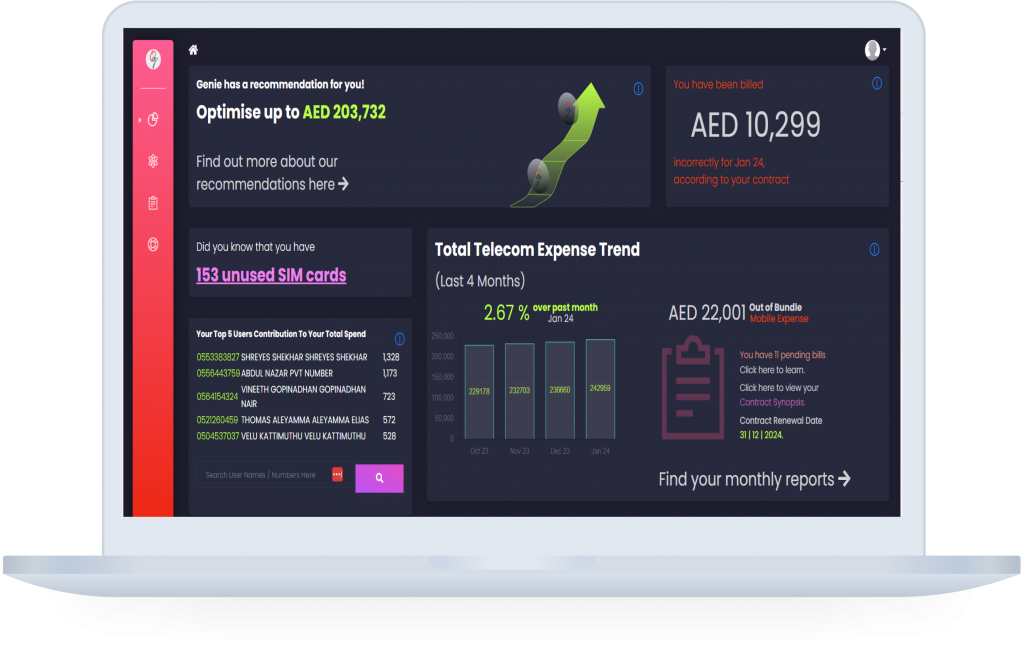
The Ajackus team built the client-facing analytics interface using Angular and ChartJS, giving enterprise finance teams and procurement managers a consolidated view of their telecom spend. The dashboard surfaces operator-level cost breakdowns, month-on-month trend analysis, discrepancy summaries by category and severity, and total recoverable-cost calculations. The choice of ChartJS within the Angular framework was driven by the requirement to render complex, multi-series financial data clearly within the same session as invoice review.
Testing and Quality Assurance with JUnit
Given the financial consequences of incorrect validation — a false positive discrepancy triggers a commercial dispute; a false negative means a missed recovery — the Ajackus team invested heavily in automated testing using JUnit. The validation logic was built with comprehensive unit and integration test coverage, ensuring that the comparison engine produces consistent, accurate results across the full range of invoice formats, contract structures, and edge cases encountered in real enterprise billing data.
Results
The OpexGenie platform has processed over 1 million bill pages across 30,000+ enterprise invoices, identifying 15–20% in recoverable or avoidable telecom costs for clients — savings that were entirely invisible before automated validation existed.
1M+
Bill Pages Processed
30,000+
Invoices Analysed
15–20%
Average Customer Cost Savings
What went well:
Operational Improvements
- Over 30,000 enterprise telecom invoices ingested, parsed, and validated — a volume that would require a full-time analyst team to process manually, now handled automatically within each billing cycle
- Invoice processing across three major GCC operators (DU, Etisalat, STC) handled by a single platform, eliminating operator-specific manual workflows
- Enterprise clients receive actionable discrepancy reports within their billing cycle, maximising the commercial window for cost recovery
- Configurable rate-card upload allows OpexGenie to onboard new enterprise clients without platform code changes
Technical Achievements
- 1 million-plus bill pages processed through the multi-operator ingestion and normalisation engine without data loss or processing failures
- Spring Boot backend and Docker containerisation on AWS deliver horizontal scalability validated to support significant volume increases without rearchitecting
- JUnit-tested validation logic with comprehensive unit and integration test coverage ensuring mathematical accuracy across all supported invoice formats
- Operator-specific parsing modules for DU, Etisalat, and STC normalise disparate invoice formats into a unified PostgreSQL data model
- Angular and ChartJS analytics dashboard renders complex multi-operator, multi-period spend data in a consolidated interface
Business Impact
- Enterprise customers identify an average of 15–20% in recoverable or avoidable telecom costs — savings systematically invisible before automated validation
- OpexGenie can now serve enterprise clients with multi-operator telecom environments as a single integrated engagement
- The platform’s configurable architecture positions OpexGenie to expand coverage to additional GCC operators without rebuilding core infrastructure
Why It Worked
Accuracy as a Commercial Requirement
In telecom cost recovery, an incorrect discrepancy identification has commercial consequences — it triggers a dispute process that damages the client relationship. The Ajackus team treated validation accuracy as a non-negotiable design requirement, building comprehensive JUnit test coverage into the validation engine before a single real invoice was processed. This investment in correctness is what made the platform commercially deployable.
Architecture Matched to Growth Trajectory
Rather than building for OpexGenie’s current invoice volume, the Ajackus team designed the AWS and Docker architecture for the client’s projected growth. The decision to invest in scalable infrastructure from the outset — rather than retrofitting it when volume pressure emerged — means the platform can absorb new enterprise clients and new operators without engineering intervention at each growth stage.
Validation Logic Decoupled from Client Config
The contract validation engine was built as a configurable rules layer, deliberately separated from client-specific rate-card data. OpexGenie can onboard a new enterprise client by uploading their rate card — no code changes required. The Ajackus team recognised that each new enterprise client has a different contract structure, and built for that variability from day one rather than treating it as an edge case.
Frequently Asked Questions
How does the OpexGenie platform validate telecom invoices against contract rates?
The platform ingests enterprise telecom invoices from operators including DU, Etisalat, and STC, parses each invoice through an operator-specific extraction module, and normalises the resulting line-item data into a unified data model. The validation engine then compares each charge against the applicable rate from the client's uploaded contract rate card. When a discrepancy is detected — an overcharge, an unauthorised service, or a billing code not present in the contract — the system flags it with the information needed to initiate a recovery claim. This process runs automatically within each billing cycle, replacing manual spot-checking.
What volume of invoices can the OpexGenie platform handle?
The platform has processed over 1 million bill pages across more than 30,000 invoices, and the Spring Boot backend with Docker containerisation on AWS is architected to scale horizontally as invoice volumes grow. The Ajackus team designed the infrastructure for OpexGenie's projected growth trajectory, so the platform can absorb significant volume increases — additional enterprise clients, additional operators — without rearchitecting the core system.
How does OpexGenie handle the fact that DU, Etisalat, and STC all format their invoices differently?
Ajackus built operator-specific parsing modules for each supported operator. Each module handles the nuances of that operator's invoice format — field naming conventions, data structures, billing code schemas — before passing normalised data to the shared validation layer. This architecture means adding a new operator requires building a new parsing module, not restructuring the validation or analytics layers. The normalised data model in PostgreSQL ensures that cross-operator analysis and reporting is consistent regardless of how different the original invoice formats are.
What average savings do enterprise clients achieve using OpexGenie?
Enterprise customers identify an average of 15–20% in recoverable or avoidable telecom costs. These savings represent the gap between what enterprises are billed and what their contracts entitle them to be charged — a gap that exists in most enterprise telecom relationships but is invisible without automated validation. The 15–20% figure is derived from the platform's analysis of 30,000+ invoices across enterprise clients with multi-operator telecom environments.
How quickly can Ajackus build a data-intensive validation platform like OpexGenie?
The OpexGenie engagement demonstrates Ajackus's ability to deliver a cloud-native, multi-operator data processing platform — backend validation engine, analytics dashboard, and production AWS infrastructure — within a focused managed delivery engagement. Ajackus operates across three engagement models: Team Augmentation, Managed Delivery, and Build-Operate-Transfer. For a platform of OpexGenie's complexity, Ajackus typically onboards a scoping team within two weeks of engagement confirmation. The platform's configurable architecture means the initial build also provides the foundation for subsequent operator and client expansions.
Can Ajackus build platforms that process sensitive financial data at enterprise scale?
Yes. The OpexGenie platform processes enterprise telecom billing data — including contractual rate information and invoice charge histories — at a scale of 1M+ pages and 30,000+ invoices. The Ajackus team's architecture choices for this engagement — AWS infrastructure, PostgreSQL for structured financial data, Docker for deployment consistency, and JUnit for validation accuracy — reflect the engineering standards required for financial data processing at enterprise scale. Ajackus has delivered similar data-intensive platforms across fintech, enterprise software, and regulated industries.








Let’s Build your Project Together