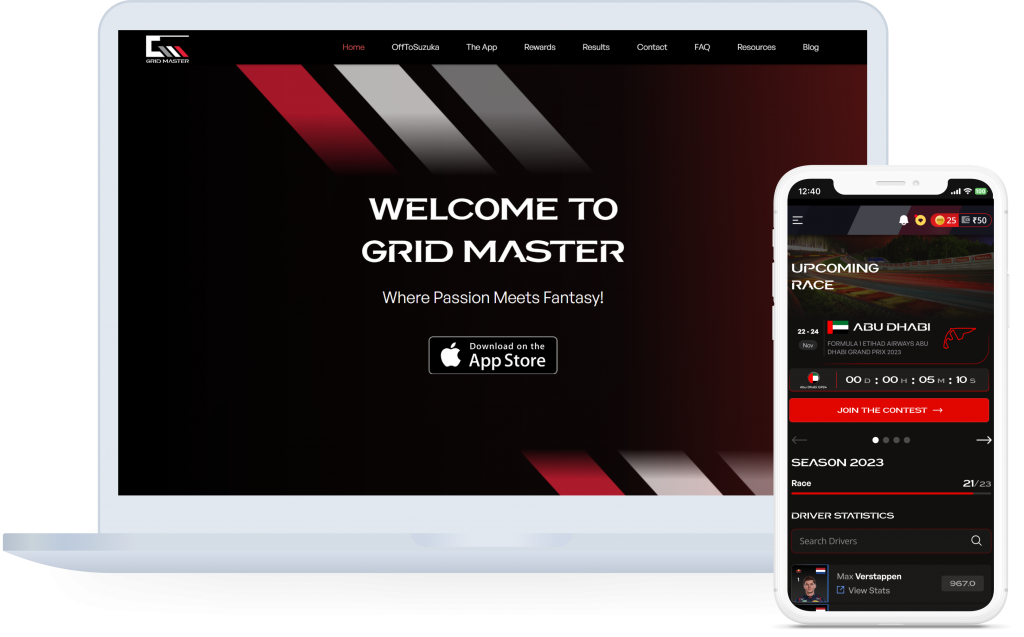
Ajackus partnered with Team Grid Master — an India-based fantasy sports startup targeting Formula 1 fans — to design and build a secure, multi-platform fantasy gaming application from the ground up, delivering a fully operational product that successfully ran two complete Grand Prix seasons.

Engagement Model
Team Augmentation
Your team, supercharged — every Ajackus engineer comes AI-native, shipping 40–60% faster from day one
Managed Delivery
Tell us the problem. We handle everything — discovery, architecture, build, testing, deployment — at AI speed
BOT Model
We build your offshore engineering center with AI-trained teams, operate it to maturity, then transfer ownership to you
Expertise
AI Development
Custom AI agents, LLM integrations, RAG pipelines, and AI enablement — from strategy to production
Web Development
Enterprise web applications built with AI-augmented engineering for 40-60% faster delivery
Mobile Development
Native and cross-platform mobile apps built at AI pace with rigorous automated quality
DevOps
Infrastructure that scales automatically, deploys safely, and costs less
Low-Code/No-Code
Airtable, Glide, Shopify, and WordPress solutions with AI automation layers — built in days
Data Analytics
Turn raw data into decisions that drive revenue — 80% faster with AI-assisted analytics
UI/UX Design
User-centered interfaces designed with AI-powered speed — 3x faster iteration, sharper insights


How Gridmaster Launched a Compliant Formula 1 Fantasy Gaming Platform Across iOS, Android, and Web with Ajackus
Services
Web Development
Mobile Development
Technologies




7
Third-Party APIs Integrated
2
Full Grand Prix Seasons Delivered
21–24
Races Managed Per Season
Overview
Executive Summary
Client Overview
The Challenge
Project Goals
Our Approach
Results and Impact
Frequently Asked Questions
Executive Summary
The Problem
Team Grid Master had a compelling vision for India’s first dedicated Formula 1 fantasy gaming platform but lacked the technical team or product development experience to build a secure, scalable, multi-platform application capable of handling real money, sensitive user data, and live race-day contest management.
The Solution
Ajackus built Gridmaster end-to-end — native iOS and Android apps via React Native, a React-based web platform, and a centralised web admin dashboard — integrating seven third-party APIs and implementing a full security and compliance framework covering Financial Information, Sensitive Private Information (SPI), and Personally Identifiable Information (PII).
The Result
Gridmaster successfully completed two full Formula 1 Grand Prix seasons, each spanning 21–24 races, operating live contests and distributing winnings without a compliance incident. The Ajackus team delivered a production-ready platform that freed the client entirely from developer dependency for day-to-day business operations.
Client Overview
Team Grid Master is an Indian fantasy sports startup focused exclusively on Formula 1 — a niche that sits at the intersection of one of motorsport’s most technically complex sports and one of the world’s fastest-growing fantasy gaming markets. The team came to Ajackus with a product concept, domain expertise in F1, and a clear ambition: to replicate the engagement depth of platforms like Dream11 but for Formula 1 fans across India.
The engagement with Ajackus was a full managed delivery — Gridmaster did not previously exist as a product. Ajackus took the project from concept through design, development, compliance configuration, and production launch.
| Industry | Fantasy Sports / Gaming |
| Target Market | Formula 1 fans across India |
| Platform Scope | iOS, Android, Web |
| Headquarters | India |
| Engagement Model | Managed Delivery — full product build from scratch |
Challenge
The Bottom Line
Team Grid Master needed a production-grade fantasy gaming platform — secure, multi-platform, and compliant with financial and data privacy standards — built from zero by an engineering partner with full product ownership capability.
Building a fantasy gaming application that handles real money is categorically different from building a standard consumer app. The Ajackus team faced four interconnected challenges that had to be resolved in parallel.
User Experience at the Standard of Dream11
The Indian fantasy gaming market is dominated by Dream11, which has spent years refining an engagement model that Indian users find intuitive, fast, and compelling. For Gridmaster to attract and retain Formula 1 fans, the user experience could not be generic — it needed to match or approach that benchmark from day one. The Ajackus team conducted a detailed audit of Dream11’s design patterns and interaction flows, using those insights to inform the Gridmaster product architecture and interface design, whilst tailoring the experience to the specific rhythms of Formula 1 race weekends (qualifying, race day, driver performance scoring, etc.).
Security and Compliance for a Financial Product
Gridmaster handles real money. That means Financial Information, Sensitive Private Information (SPI), and Personally Identifiable Information (PII) must be protected to a standard that meets both regulatory requirements and user trust expectations. Without a proper security framework, the platform would face legal exposure and user churn the moment any incident occurred. The Ajackus team engaged cybersecurity expertise to assess data handling practices, implement encryption protocols, define access controls, and ensure compliance with applicable data protection regulations before a single rupee moved through the system.
Third-Party API Integration Complexity
A live fantasy gaming platform requires multiple external services to function — payment processors, identity verification, data providers, and more. Each API integration introduces a new failure point, a new dependency to maintain, and a new surface for security risk. The Ajackus team evaluated, selected, and integrated seven third-party APIs, ensuring each was tested under realistic race-day load conditions before go-live.
Giving the Client Full Operational Independence
A common failure mode in startup product development is building a platform where every routine operation — creating a contest, adjusting payout rules, publishing results — requires a developer to intervene. This creates bottlenecks and operational fragility. Team Grid Master needed to be able to run their business without Ajackus once the product launched.
Goals
The project focused on building a complete fantasy gaming platform from scratch, with security, compliance, and operational independence as core requirements.
| Goal | Outcome Required |
|---|---|
| Build cross-platform fantasy gaming app | iOS, Android, and web — single codebase where possible |
| Match Dream11-level UX quality | Intuitive navigation, minimal clicks, fast performance |
| Implement financial and data compliance | Encryption, access controls, PII/SPI/Financial data protection |
| Integrate third-party services | 7 APIs integrated and tested pre-launch |
| Build web admin platform | Client manages all operations without developer dependency |
| Launch in time for Formula 1 season | Full Grand Prix season readiness — 21–24 races |
Journey
Ajackus took Gridmaster from concept to production across five structured phases, handling everything from UX research to App Store compliance.
Phase 1: Discovery, UX Research, and Architecture Design
The Ajackus team began by conducting a thorough UX audit using Dream11 as the primary benchmark. This was not a copy exercise — it was a structured analysis of what makes fantasy gaming platforms retain users: speed of team selection, clarity of scoring rules, immediacy of results, and the social dynamics of contest leaderboards. These principles were mapped to the specific cadence of Formula 1 (Practice → Qualifying → Race) and used to design an information architecture and user flow that felt native to F1 fans.
In parallel, the Ajackus team designed the system architecture to support multi-platform delivery from a shared backend, minimising future maintenance overhead and ensuring consistency of data across iOS, Android, and web.
Phase 2: Multi-Platform Application Development
Using React Native for the mobile applications and React for the web platform, the Ajackus team built Gridmaster across all three target surfaces. The development approach prioritised performance optimisation — fast load times, smooth animations during live race periods, and stability under concurrent user activity — because fantasy gaming engagement is highest precisely when server load is also highest (race day).
The mobile apps were built to App Store and Google Play publication standards, including compliance with Apple and Google platform policies relevant to real-money gaming applications.
Phase 3: Web Admin Platform Build
A centralised web admin platform was designed and built specifically to give Team Grid Master full operational control. Through this interface, the client can create and manage contests, define scoring rules, regulate winnings distribution, manage user data, and customise the experience visible to end users — all without any developer involvement.
This was a deliberate product decision by the Ajackus team: the admin platform was scoped and built as a first-class deliverable, not an afterthought. The result is that Gridmaster’s business team can adapt to each race weekend’s specific conditions — driver substitutions, race cancellations, scoring adjustments — in real time.
Phase 4: Security Framework and Compliance Implementation
The Ajackus team partnered with cybersecurity experts to conduct a full assessment of the platform’s data handling practices prior to launch. The resulting security framework included end-to-end encryption for financial transactions, role-based access controls for admin functions, and data segregation for PII and SPI. Comprehensive guidance was provided to Team Grid Master on ongoing data management, privacy management, and financial compliance obligations, ensuring the client understood not just what was built but how to maintain compliance as the platform scales.
Phase 5: Third-Party API Integration and Testing
Seven third-party APIs were evaluated, selected, and integrated into the platform — covering payment processing, identity verification, and race data services. Each integration underwent rigorous testing under simulated race-day load conditions before the platform went live. The Ajackus team worked directly with API providers to customise integration configurations that matched Gridmaster’s specific contest mechanics and payout flows.
Results
Gridmaster launched successfully and ran two complete Formula 1 Grand Prix seasons without a single compliance incident, validating the platform’s architecture, security framework, and operational model.
2
Full Grand Prix Seasons Completed
7
Third-Party APIs Integrated at Launch
0
Compliance Incidents Across Both Seasons
What went well:
Operational Achievements
- Successfully completed two full Formula 1 Grand Prix seasons, each spanning 21–24 races
- 7 third-party APIs integrated, tested, and operational at launch with zero post-launch integration failures
- Live contest creation, management, and winnings distribution ran without a compliance incident across both seasons
- The web admin platform eliminated developer dependency for all routine business operations from Day 1 post-launch
Technical Achievements
- Multi-platform delivery across iOS, Android, and web from a unified product architecture
- Security and compliance framework implemented covering Financial Information, SPI, and PII — fully operational before first real-money transaction
- Performance-optimised mobile application published to the Apple App Store and Google Play Store
- Admin platform built with full content management, contest control, and user data management capability
Business Impact
- Team Grid Master moved from zero product to a fully operational, revenue-generating fantasy gaming platform within a single product development cycle
- The client now operates Gridmaster’s seasonal business independently — no ongoing developer dependency for contest management or platform administration
- The platform is positioned to scale to additional Formula 1 seasons and, potentially, additional motorsport verticals without architectural rearchitecting
Why It Worked
Security Built In, Not Bolted On
The Ajackus team engaged cybersecurity expertise during the design phase — not after development. This meant the encryption architecture, access controls, and compliance framework were foundational to the platform rather than retrofitted. For a real-money application, this approach is the difference between a compliant launch and a regulatory exposure.
Admin-First Product Philosophy
Rather than treating the web admin platform as an internal tool, the Ajackus team scoped it as a core product deliverable. The result is that Team Grid Master can run a full Grand Prix weekend — from contest creation to winnings distribution — without engineering support. This operational independence is what allows the business to scale without scaling its engineering costs at the same rate.
Benchmark-Driven UX Design
The Ajackus team did not guess at what makes fantasy gaming engaging for Indian users — they studied Dream11’s design patterns systematically and applied those insights to the Formula 1 context. The resulting UX maps to how F1 fans actually consume race weekends, creating a product that feels purpose-built rather than adapted from a generic template.
Frequently Asked Questions
How does the Gridmaster platform handle real-money contests and winnings distribution?
Gridmaster manages financial transactions through a set of integrated third-party payment APIs, selected by the Ajackus team for their reliability, regulatory compliance, and compatibility with Indian payment infrastructure. Winnings are distributed through the platform's automated contest management system, which the Gridmaster business team controls directly via the web admin dashboard — no developer involvement is required at any stage of the contest lifecycle.
What security measures protect user financial and personal data on Gridmaster?
The Ajackus team implemented a comprehensive security framework prior to Gridmaster's launch, covering Financial Information, Sensitive Private Information (SPI), and Personally Identifiable Information (PII). This includes end-to-end encryption for financial transactions, role-based access controls for administrative functions, and data segregation protocols that keep sensitive user data isolated from general application data. The framework was built to comply with relevant Indian data protection and financial regulations.
How did Ajackus approach building for Formula 1 specifically, rather than a generic fantasy sports format?
The Ajackus team conducted a structured UX analysis of the leading Indian fantasy gaming platforms — particularly Dream11 — and mapped those engagement principles to the specific cadence of Formula 1: practice sessions, qualifying, and race day. The product architecture, scoring mechanics, and contest flows were all designed around how F1 fans consume race weekends, resulting in a platform that feels native to the sport rather than adapted from a cricket or football template.
How quickly can Ajackus take a consumer app idea from concept to production launch?
Ajackus operates across three engagement models — Team Augmentation, Managed Delivery, and Build-Operate-Transfer. For Gridmaster, Ajackus operated in Managed Delivery mode, taking full ownership from discovery through design, development, security implementation, and App Store publication. For a project of this complexity — multi-platform, real-money, compliance-bound — the timeline is typically 4–8 months depending on scope. Ajackus can embed a scoping team within 2 weeks of engagement confirmation.
How does Ajackus handle knowledge transfer once a product is built?
The Gridmaster engagement included deliberate knowledge transfer as a core deliverable. The web admin platform was designed so that Team Grid Master's business team — not engineers — can manage all operational functions: contest creation, scoring configuration, user management, and winnings distribution. The Ajackus team also provided comprehensive guidance to the client on data management, privacy obligations, and financial compliance, ensuring operational continuity after handover.
Can Ajackus build apps that comply with both Apple App Store and Google Play policies for real-money gaming?
Yes. The Gridmaster iOS and Android applications were built and published to both platform stores in full compliance with Apple and Google's real-money gaming policies. This included appropriate age-gating, terms and conditions flows, and jurisdictional compliance configurations. The Ajackus team's experience with regulated consumer applications means platform policy compliance is addressed during development — not discovered during app review.








Let’s Build your Project Together